
Phone:
+231 77 822 9348
Physical address:
Center and, Carey St, Monrovia 1000, Liberia

In today’s connected world, cybersecurity threats for businesses are no longer limited to global corporations. Across Monrovia and other parts of Liberia, local enterprises — from NGOs and UN agencies to private companies and government offices — are increasingly targeted by hackers and cybercriminals.
Weak security setups, outdated software, and limited awareness often leave Liberian businesses exposed to data breaches, ransomware attacks, and financial fraud.
At Planet PC Liberia, we understand that strong cybersecurity is not a luxury — it’s a necessity. As a trusted provider of ICT Products, Cybersecurity Solutions, and Networking Services in Monrovia, we’ve seen how even small vulnerabilities can lead to big losses. Let’s explore the five most common cybersecurity threats businesses in Liberia face — and how to prevent them effectively.
When organizations plan a major ICT project, one of the first discussions is often about equipment. What server should we purchase? Which firewall should we use? How many cameras are required? Which network switch is suitable? How much storage do we need? What should the project cost?
These are important questions. But they are not the first questions an organization should ask.
What problem are we trying to solve? | What does the organization actually need? | How should all the technology work together?
This is where an ICT Project Consultant becomes valuable.
As Liberia continues its digital transformation, government institutions, development projects, NGOs, banks and private organizations are implementing increasingly complex technology environments. Liberia’s National Digital Strategy 2025-2029 establishes a framework for the country’s digital development, while the National Cybersecurity Strategy 2025-2029 places additional emphasis on building a secure and resilient digital environment.
In April 2026, Executive Order No. 163 also established a central government structure for coordinating digital governance, enterprise architecture and cybersecurity across ministries, agencies and commissions.
At the same time, the World Bank approved a $137 million regional digital integration initiative covering Liberia, Benin and Sierra Leone to strengthen the foundations of the regional digital economy.
As technology investments grow, so does the importance of professional ICT project planning and management.
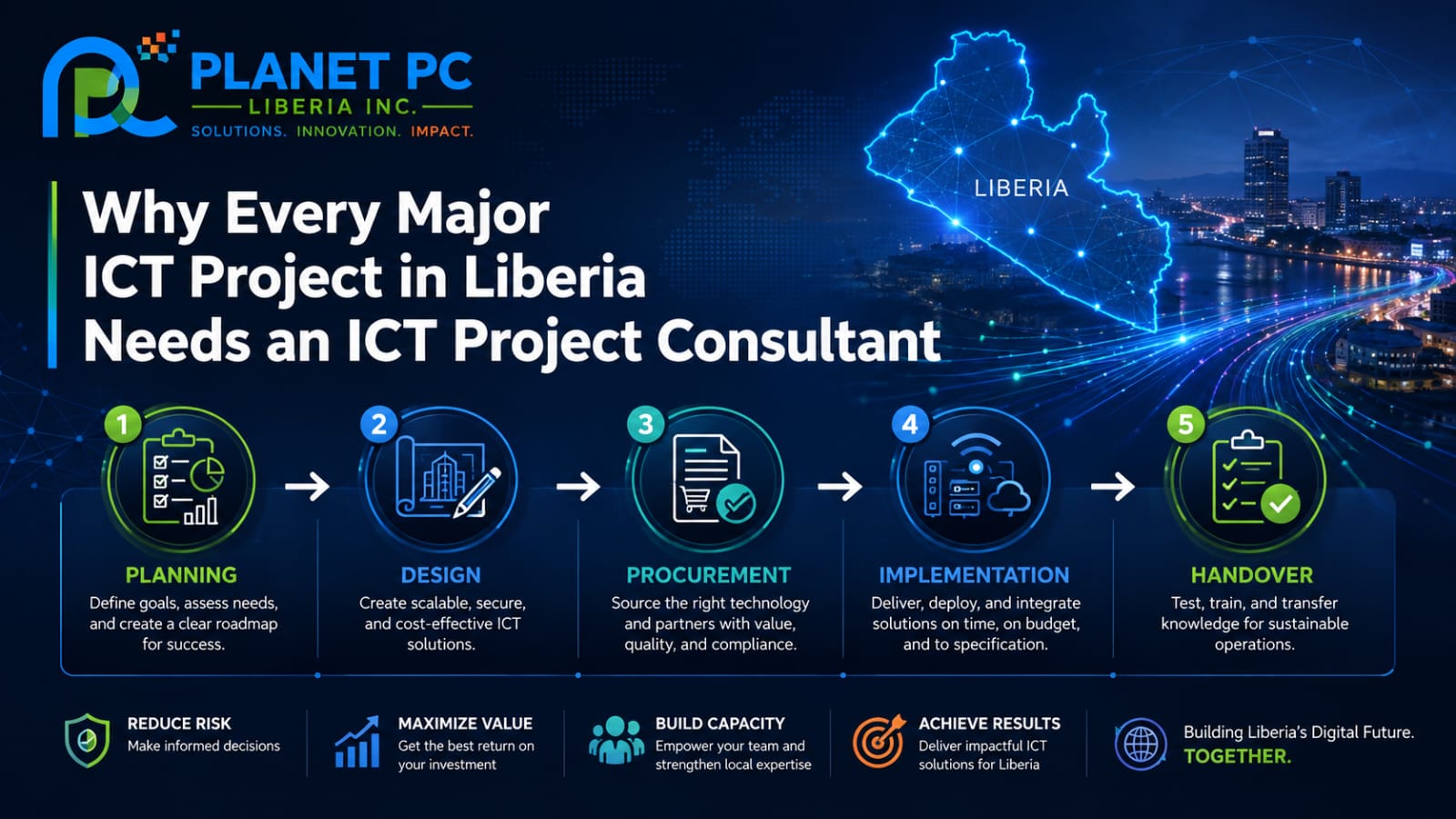
An ICT Project Consultant is a technology professional or consulting organization that helps a client transform a business or operational requirement into a properly designed and implementable ICT solution.
The consultant does not simply recommend a laptop, server or network switch. The consultant looks at the entire project lifecycle.
Requirement Assessment -> Solution Design -> Technical Specifications -> BOQ -> Budget -> Procurement Support -> Implementation -> Testing -> Handover
For complex projects, this approach can significantly improve coordination between the client’s management team, ICT department, procurement team, vendors, contractors, OEMs and end users.
Many ICT project problems begin before procurement. An organization knows that it needs a new system, but the requirement has not been properly defined.
For example, an organization may say: “We need a CCTV system.” But an ICT Project Consultant needs to understand much more.
Without these questions, it is difficult to prepare an accurate technical design or budget. The same principle applies to data centers, networking, cybersecurity, cloud infrastructure, access control, business applications and almost every other ICT project.
Once the requirements are understood, they need to be translated into a practical solution. This is one of the most important roles of an ICT Project Consultant.
Without an overall design, individual components can be technically good but still fail to work properly together. An ICT project should therefore be designed as one integrated system, not simply as a collection of products.
A major ICT procurement depends heavily on the quality of its technical specifications and Bill of Quantities. Poor specifications can create several problems:
An ICT Project Consultant can help develop specifications that describe the required performance, capacity, functionality, compatibility and implementation requirements. The objective should not simply be to specify products – it should be to clearly define what the solution must achieve. A properly developed BOQ should also consider the complete implementation requirement, including accessories, licenses, installation, testing, documentation and training.
Another common challenge is determining the real cost of an ICT project. Equipment is only one component. A complete project budget may include:
An ICT Project Consultant can help the client understand the total project requirement rather than focusing only on equipment pricing. This allows organizations to plan funding more realistically and reduce unexpected costs during implementation.
Technical procurement can become difficult when the procurement team receives proposals containing different brands, architectures and technical approaches. An ICT Project Consultant can help procurement and technical teams understand whether proposed solutions meet the project’s actual technical requirements.
For government and donor-funded projects, consulting, procurement and bidding roles must be structured carefully. Applicable procurement rules may contain conflict-of-interest requirements, and organizations should ensure that consultants, evaluators, bidders and suppliers have clearly defined roles consistent with the applicable procurement framework. The World Bank procurement framework specifically addresses conflict-of-interest requirements in project procurement.
There are many respected technology manufacturers. However, no single manufacturer is automatically the correct answer for every project. The correct solution depends on factors including:
An ICT Project Consultant helps evaluate technology according to the project requirement. This helps organizations avoid both under-designing and unnecessarily over-designing their systems.
Large ICT projects frequently involve multiple technologies. A project could include servers, storage, networking, firewall, CCTV, access control, UPS, fiber, cloud and software. Different products may come from different manufacturers, and different contractors may be responsible for various portions of the project.
Effective coordination becomes particularly important when one contractor’s work depends on another contractor completing something first.
A good technical design has little value if the installation is poorly executed. Implementation should therefore be monitored against the approved design and project requirements.
Problems identified during implementation are usually easier to correct than problems discovered after the project has been handed over.
The fact that equipment powers on does not mean that a project is complete. Before acceptance, systems should be tested against predefined acceptance criteria wherever possible.
Testing gives both the client and the implementer a clear understanding of when the project is considered successfully completed.
One of the most overlooked aspects of ICT projects is documentation. After implementation, the organization should not depend entirely on one engineer remembering how the environment was configured.
Good documentation makes future maintenance, troubleshooting, audits and upgrades significantly easier.
Technology becomes useful only when people can operate it properly. Training should therefore form part of major ICT implementations.
The objective is not necessarily to turn every user into an engineer. It is to ensure that the client’s team understands the system well enough to operate it effectively and know when specialist support is required.
ICT projects do not end on commissioning day. Organizations need to consider what happens afterward.
These requirements should be discussed during project planning rather than after a problem occurs.
The complexity increases significantly when technology must be deployed across several offices, counties or remote locations. Multi-site projects require planning for:
Planet PC Liberia’s published project experience includes the supply, installation and commissioning of ICT equipment and digital-learning platforms for 156 public senior secondary schools across all 15 counties of Liberia, demonstrating the scale of coordination required for nationwide technology deployments.
Large deployments need strong technical planning before equipment begins moving to project sites.
The complexity increases significantly when technology must be deployed across several offices, counties or remote locations. Multi-site projects require planning for:
Planet PC Liberia’s published project experience includes the supply, installation and commissioning of ICT equipment and digital-learning platforms for 156 public senior secondary schools across all 15 counties of Liberia, demonstrating the scale of coordination required for nationwide technology deployments.
Large deployments need strong technical planning before equipment begins moving to project sites.
Ideally, an ICT Project Consultant should be involved at the beginning of the project – not after equipment has already been purchased. The best time is when the organization has identified a business or operational requirement but has not finalized the solution.
Need Identified -> Site & Requirement Assessment -> Solution Architecture -> Technical Specifications & BOQ -> Budget -> Procurement Support -> Implementation -> Testing & Commissioning -> Training & Documentation -> Handover -> Support
This creates continuity from the original requirement to the final operational system.
Organizations should evaluate more than academic qualifications when selecting an ICT consultant. Consider whether the consultant understands:
Most importantly, the consultant should be capable of connecting technology decisions with the organization’s actual operational objectives.
At Planet PC Liberia Inc., we believe major technology projects should begin with understanding the requirement – not selecting the product.
Planet PC’s current portfolio covers ICT equipment, networking and cabling, storage, security systems and other technology solutions, while its publicly documented experience includes government, institutional and nationwide ICT implementations.
Our ICT project support can assist organizations through areas such as:
The exact engagement should always be structured according to the client’s procurement framework, project requirements and any applicable conflict-of-interest rules.
Whether your organization is planning a data center, network upgrade, cybersecurity project, CCTV system, access-control deployment, cloud migration, backup environment, digital platform or nationwide ICT rollout, involving the right technical expertise early can make a significant difference.
A properly planned ICT project should deliver more than equipment. It should deliver a secure, scalable, supportable and operational technology environment that meets the organization’s actual needs.